Stop Selling Other People's Equipment—Build Your Brand Instead
_1784817635108.png) Bill Brown
Bill BrownEvery major HVAC manufacturer builds to the same third-party AHRI-certified performance standards and sources most components from the same suppliers. Goodman equipment typically costs 15–20% less at wholesale than comparable Carrier or Trane systems. A contractor who installs under their own private label earns more margin per job, builds customer loyalty to their company rather than a manufacturer that won't answer the phone when something fails, and owns a brand asset that increases the eventual sale value of their business.
The HVAC industry has a problem no one talks about: contractors are defending the reputation of manufacturers that don't care about them, their employees, or their customers.
Carrier. Lennox. Trane. Rheem. York.
Big names, shiny logos—and none of them show up when your customer's system fails.
When a compressor dies six months after install, who answers the call?
Not the manufacturer. You do.
They'll ship a replacement part, maybe. But that doesn't cover your labor, your overhead, or the hit to your reputation. And that "labor warranty" you paid hundreds for? You'll be lucky to recover a fraction of what the job actually costs.
The Hard Truth
If you don't believe your brand is stronger than theirs, you're burning money every day.
It's your responsibility—not an option—to grow your business ethically and maximize profit. You owe that to your team, your customers, and your family.
Profit isn't greed. It's fuel. It's how you pay people well, serve customers better, and build a company that's worth buying one day.
Every buyer who evaluates your business looks at two things: steady growth and strong margins.
You can't have either while paying premium prices for someone else's logo.
The margin reality is stark. According to IBISWorld's HVAC industry data, the average profit margin for U.S. HVAC contractors is 2.5–5% — among the thinnest of any skilled trade. Equipment cost is typically the single largest line item in a replacement job, representing 35–55% of the total invoice. A contractor paying a brand premium on every unit is compressing margins they can barely afford to lose.
The Wake-Up Call: All HVAC Equipment Is Basically the Same
I've been in this trade for 25 years—residential, commercial, and engineering.
I hold a degree in HVAC and worked in quality engineering at Liebert (now Vertiv), the world leader in precision cooling for data centers.
Liebert systems often cost six figures each and cool server racks worth millions, inside data centers larger than football fields. When a system goes down there, it's not "Mrs. Jones calling because she's hot." It's a data center manager panicking over millions in uptime. That world taught me that quality and support aren't optional—they're everything.
I've also audited the assembly lines at Carrier, Copeland, Rheem, Trane, and Goodman.
Here's what I found: every major manufacturer must pass third-party UL and AHRI testing in psychrometric chambers. That means their equipment is independently verified for performance and safety—not marketing fluff.
These factories run world-class quality systems—ISO-certified, automated, and precise. They track tolerances, measure airflow and efficiency, and maintain tight control over process quality.
In other words, they're all building to the same standards.
The AHRI certification program tests and publishes performance data for more than 5 million individual product models across every major manufacturer. Each unit must be independently verified for its rated capacity, efficiency (SEER2/HSPF2), and safety compliance in accredited psychrometric test chambers. Every certified Goodman unit cleared the same external verification process as every certified Carrier or Trane unit. The performance label is not branding — it is independently verified proof.
Most manufacturers only make the cabinets, coils, heat exchangers, and sometimes their own thermostats.
Everything else comes from the same suppliers:
- Pressure switches: Honeywell, White-Rodgers
- Motors: GE, Emerson
- Circuit boards: Honeywell, White-Rodgers
- Fan blades: Lau, Dayton
- Flame sensors: Honeywell, Robertshaw
- Inducer motors: Fasco
- Compressors: Copeland
- Contactors: White-Rodgers, Packard, Eaton
- Capacitors: Titan, AmRad
Procurement departments constantly push for lower-cost parts—and they always win.
So why are the "name brands" more expensive?
Because you're paying for their marketing, not their materials.
Some even charge you to sell their logo.
When I Woke Up
Early in my career, I sold Carrier, Lennox, and Trane—because I thought I needed their brand to close sales.
But every time those systems failed, I was the one showing up to fix them.
Let's be honest: they all fail at about the same rate. I've installed thousands.
The U.S. Department of Energy cites 15–20 years as the standard operating lifespan for HVAC systems across all major brands — with variance driven by installation quality, refrigerant charge accuracy, duct design, and maintenance frequency. Brand name is not listed as a factor. That aligns exactly with what I observed across thousands of installs: a well-installed Goodman outlasts a poorly-installed Carrier every time.
So I stopped selling their brand and started selling mine.
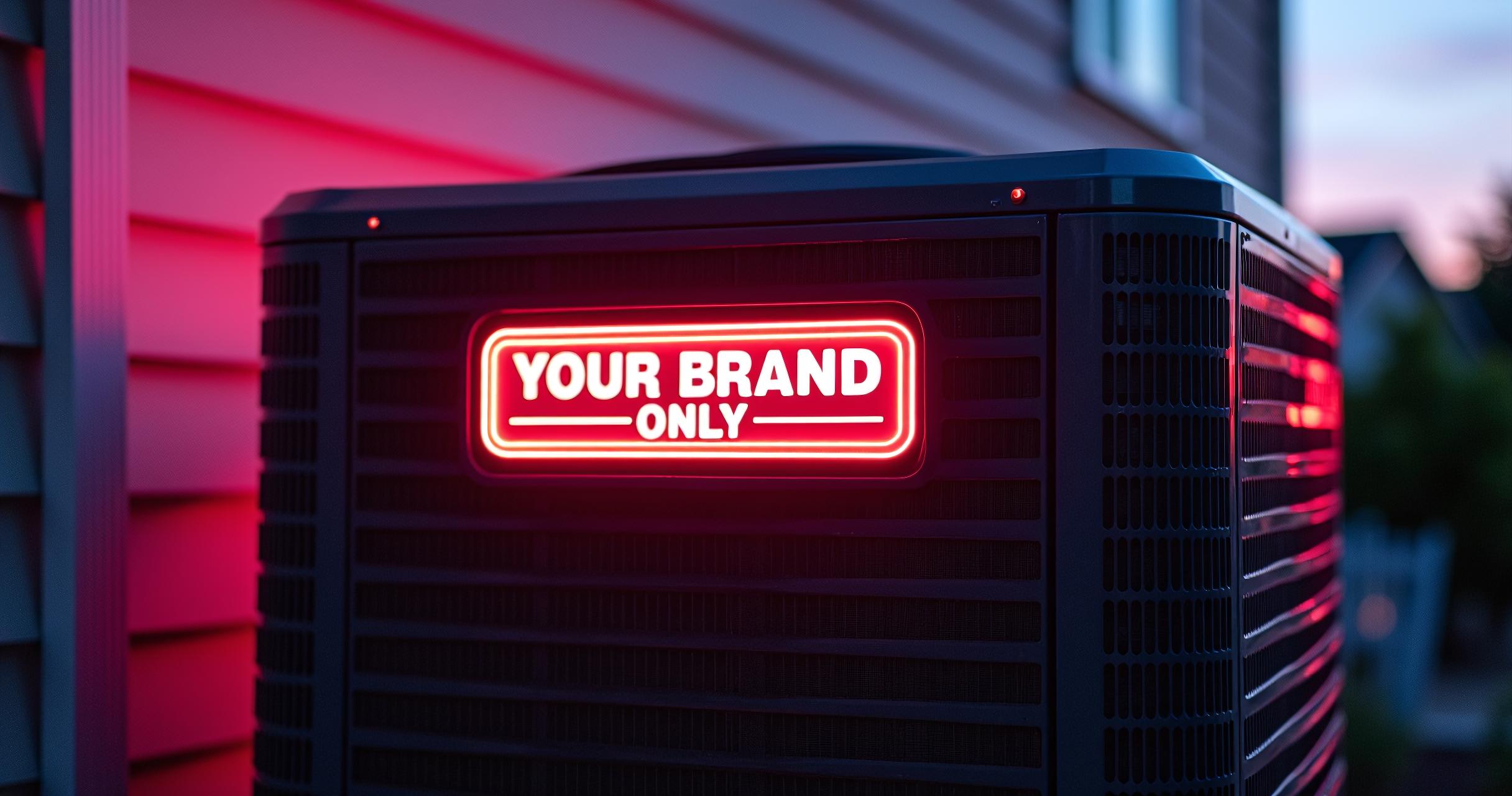
We even designed custom nameplates to fit perfectly in the blank spaces.
Then I joined Goodman's private-label program for three specific reasons:
- They were 100% on board with me putting my brand on everything and even provided blanks for labeling.
- Their equipment cost roughly 20% less than other brands, allowing us to keep significantly more profit per install.
- Every system came with a 10-year parts and labor warranty backed by Goodman, proving they stood behind their product.
We didn't lose sales. We gained them.
Customers trusted our brand, not a corporate logo.
Even as one of the highest-priced companies in town, we still won—because confidence sells.
The Truth Nobody Else Will Tell You
You'll never hear this at a dealer meeting or read it in a manufacturer brochure.
If you want a company that lasts, stop building someone else's brand.
Buy the best-value equipment.
Put your name on it.
Stand behind it.
Because the only logo your customer truly cares about is the one on the truck that shows up when their system breaks.
That logo should be yours.
Common Questions
Why should HVAC contractors consider putting their own brand on equipment instead of a manufacturer's logo?
Because when a system fails, the customer calls you — not the manufacturer. If a compressor dies six months after install, it's your truck that shows up, your labor that fixes it, and your reputation on the line. If you're absorbing all the accountability, the brand on the equipment should be yours. Every customer who calls back with a problem is reinforcing your brand whether you want them to or not.
Is Goodman HVAC equipment as reliable as Carrier, Trane, or Lennox?
Yes. Every major manufacturer — including Goodman — must pass independent third-party UL and AHRI testing in psychrometric chambers. That testing is not marketing; it's independently verified performance. Most of the components inside any major brand's equipment come from the same handful of suppliers: Copeland compressors, Emerson or GE motors, Honeywell controls. The assembly lines and quality systems are world-class across the board.
How does HVAC private labeling work in practice?
You sell and install standard Goodman equipment, but you place your company's branded nameplate in the blank cabinet space the manufacturer provides for this purpose. Your logo, your name, your colors — on the equipment. To the customer, it's a system from your company, not a manufacturer brand they've heard of. Customers call you when they need service, and they remember your name, not Goodman's.
Why are premium HVAC brands like Carrier and Trane more expensive if the parts are the same?
The premium goes to marketing spend and distribution structure, not materials or manufacturing. When you pay more for a Carrier or Trane system than a Goodman, the difference is largely the brand's advertising budget and dealer network overhead. The components inside — compressors, motors, controls — often come from identical suppliers. You're paying for the logo, not better equipment.
What is Goodman's private-label dealer program?
Goodman actively supports contractors who want to put their own brand on equipment. They build cabinet spaces specifically for contractor nameplates and are transparent about supporting private-label arrangements. This lets a contractor buy equipment at Goodman's price point — typically 20% lower than comparable premium brands — and install it under their own company name rather than advertising Goodman to their customers.
Does selling private-label HVAC equipment hurt close rates or customer trust?
No — and this is the counterintuitive part. Customers trust the contractor in their home, not the brand on the equipment. When you present your own brand confidently and back it with a clear warranty, customers respond to your confidence. Bill Brown's company was one of the highest-priced contractors in their market while using private-label equipment — and still closed sales because confidence sells.